
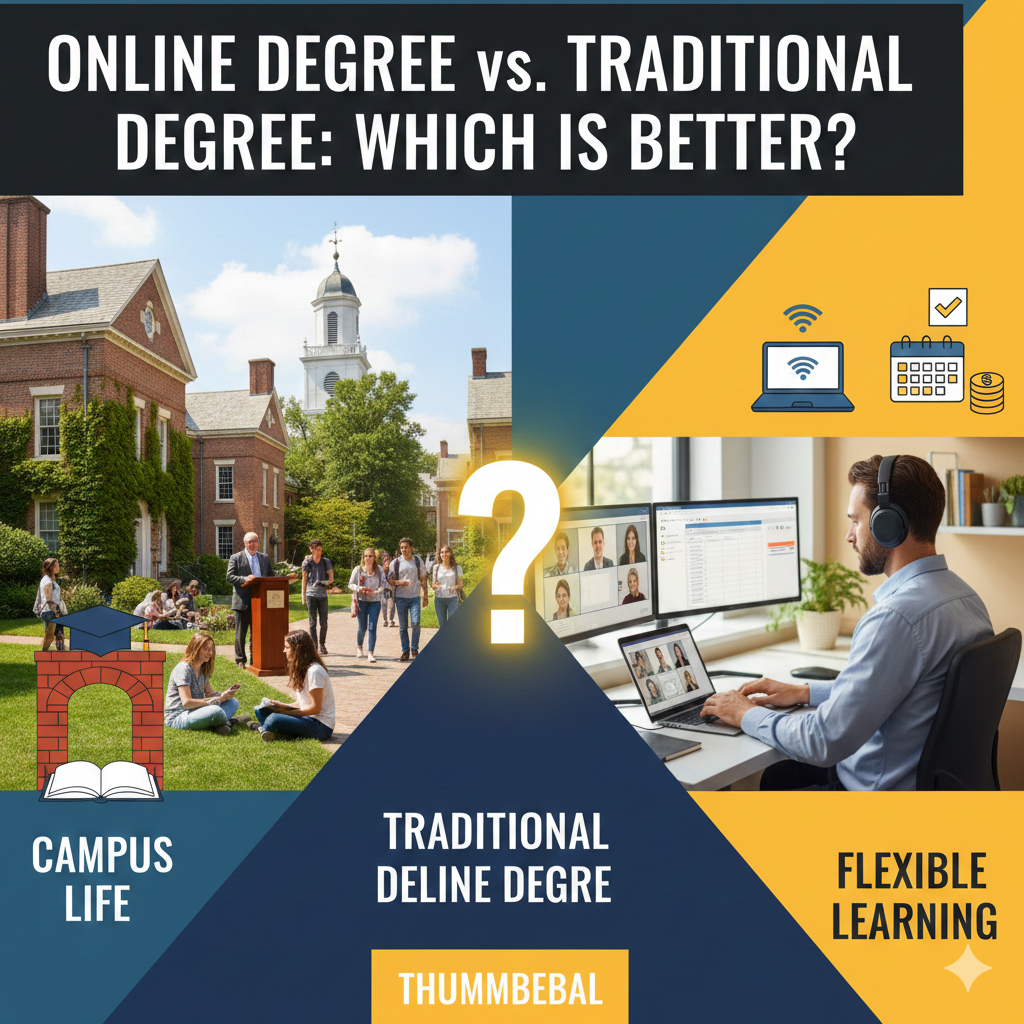
Choosing a career path used to be a straight line, but today, it feels more like a 4D maze where your bank account and your schedule are constantly at odds. If you’re staring at a tuition bill that looks like a mortgage or wondering if you can actually finish a degree while working a 9-to-5, you aren’t alone.
The real question isn’t just about which format is “better,” but which one won’t leave you burnt out and broke. In this guide, we’re going to settle the Online Degree vs Traditional Degree debate by looking at the ROI, the social trade-offs, and the hidden traps most students fall into.
What You Will Learn
- The raw cost-benefit analysis of virtual vs. campus learning.
- How to spot “degree mills” and ensure your accreditation counts.
- A breakdown of employer perceptions in 2026.
- Why the “discipline trap” is the #1 reason online students drop out.
The Shift in the Educational Landscape
For decades, the “college experience” was synonymous with ivy-covered brick buildings and lecture halls. However, the rise of distance learning has forced a massive shift in how we define a “real” education.
When comparing an Online Degree vs Traditional Degree, the primary keyword isn’t just “prestige”—it’s flexibility. Traditional degrees offer a structured environment, while online programs cater to those who need to integrate education into an existing life.
1. Financial Reality: Cost vs. Value
Let’s be blunt: college is expensive. But the ways you save money differ wildly between these two formats.
The True Cost of Traditional Degrees
On-campus students often overlook the “hidden” costs. You aren’t just paying for credits; you’re paying for:
- Room and board (often the most expensive factor).
- Commuting expenses (gas, parking permits, or public transit).
- Campus fees for gyms, laboratories, and student unions you might never use.
The Online Advantage
Online programs generally offer a lower tuition rate, but the real savings come from the lifestyle. By staying home, you eliminate the housing premium.
Pro Tip: Many online universities offer “flat-rate” tuition per term, meaning if you take extra classes, you don’t pay extra money. This is a massive win for affordable online colleges.
2. Accreditation: The “Make or Break” Factor
The biggest mistake beginners make is assuming every degree is viewed equally by the government and employers. If your school isn’t regionally accredited, your degree might be nothing more than an expensive piece of paper.
Why Accreditation Matters
- Credit Transfer: Non-accredited credits rarely transfer to other schools.
- Financial Aid: You cannot receive federal student loans or grants for unaccredited programs.
- Employer Trust: Top-tier companies check the source of your higher education to ensure the curriculum meets national standards.
Always look for “Regional Accreditation” rather than “National Accreditation,” as the former is generally held to a higher academic standard.
3. The Social and Networking Gap
This is where the traditional classroom usually wins. Education isn’t just about what you know; it’s about who you know.
- Traditional: You have face-to-face access to professors, peer study groups, and career fairs. These “hallway conversations” often lead to internships and job leads.
- Online: Networking is manual. You have to be proactive on LinkedIn, engage in digital forums, and seek out virtual learning communities. It requires more effort to build a professional circle.
4. Employer Perception: Does the “Online” Label Matter?
Years ago, there was a stigma attached to online degrees. In 2026, that stigma has largely evaporated—with one major caveat.
Employers care about the reputation of the institution, not the delivery method. If you get an online degree from a well-known state university, your diploma usually looks identical to the on-campus version. However, “for-profit” online-only schools still face some skepticism in high-stakes fields like Law or Medicine.
5. The Discipline Trap: Why Most People Fail
The “unique angle” most advisors won’t tell you is that online degrees are actually harder for most people.
In a traditional setting, you have a physical place to be at 9:00 AM. In an online setting, you are your own boss. Common mistakes include:
- Underestimating the workload: Online doesn’t mean “easier”; it often means more reading and writing to compensate for lack of lectures.
- Poor Time Management: Treating the course like a hobby rather than a job.
- Isolation: Without a physical cohort, it’s easy to lose motivation.
Which Path Is Right For You?
To help you decide, let’s look at who thrives in each environment:
Choose a Traditional Degree if:
- You are a first-time student who wants the full “college experience.”
- You struggle with self-motivation and need a fixed schedule.
- Your career path requires hands-on laboratory work or clinical hours.
Choose an Online Degree if:
- You are a working professional or have a family to support.
- You are looking for budget-friendly education and want to avoid debt.
- You are self-disciplined and comfortable using digital collaboration tools.
The Verdict
There is no universal “better” option. The Online Degree vs Traditional Degree choice depends entirely on your current lifestyle and financial boundaries.
If you value networking and structure, go traditional. If you value your time and your bank balance, online is the future. Just remember: the degree gets you the interview, but your skills get you the job.
Ready to start your journey?
Search for your preferred program’s accreditation status today to ensure your investment is protected.
Would you like me to create a comparison checklist you can use to vet specific universities?



0 Comments