
Budget Smartphones Under $300 That Feel Premium
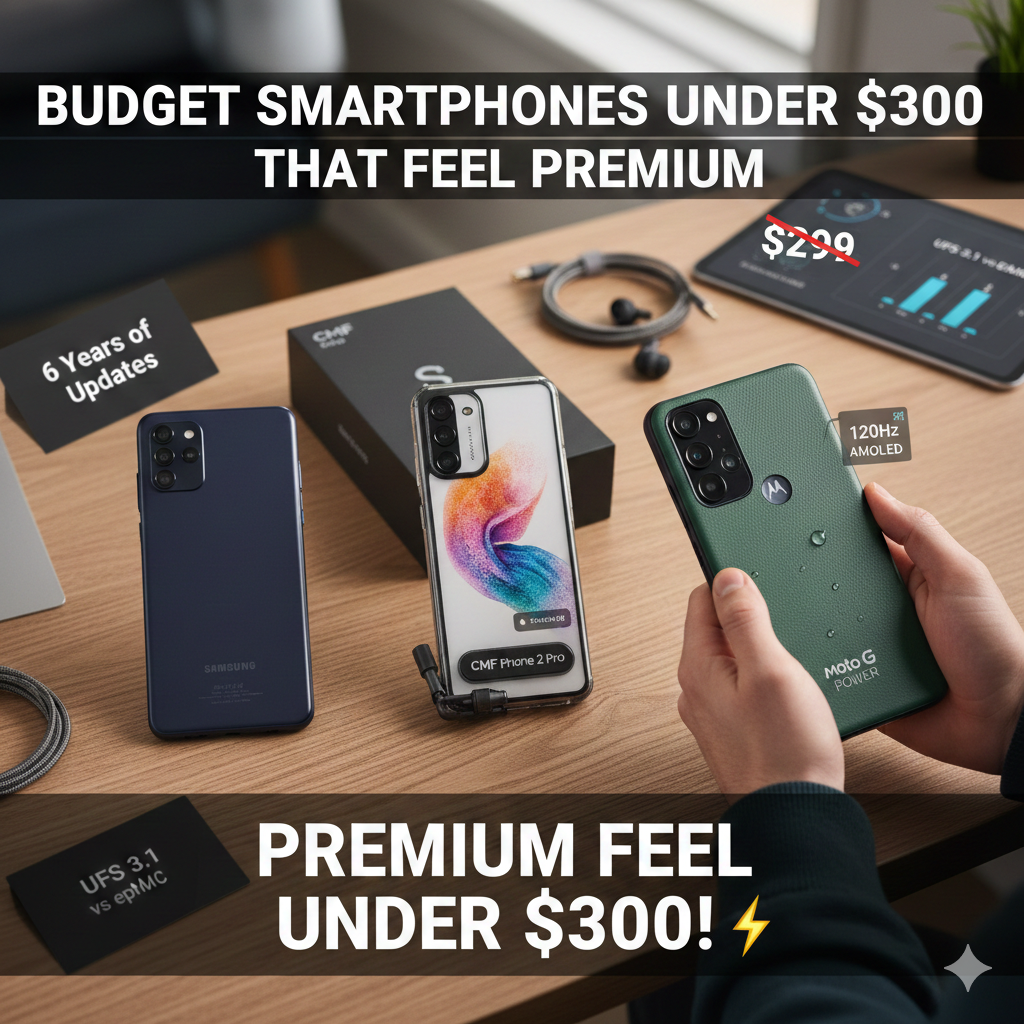
The classic dilemma: you need a new phone, but you aren’t ready to drop a month’s rent on a “Pro Max” or “Ultra” flagship. In the past, buying a budget smartphone under $300 meant settling for grainy screens, plastic that creaked under pressure, and cameras that turned sunset photos into pixelated mush.
But it’s 2026, and the “trickle-down effect” of technology has reached a boiling point. You can now get features like 120Hz AMOLED displays, vegan leather finishes, and lightning-fast charging for a fraction of flagship prices. The secret is knowing which brands are over-delivering and which are just dressing up old tech in a new shell.
What You Will Learn in This Guide:
- The top-rated budget smartphones under $300 for 2026.
- How to identify “premium” hardware in a sea of plastic.
- The most common mistakes buyers make when shopping in this price bracket.
- Which specific specs (like UFS storage and refresh rates) actually matter for a smooth experience.
1. The Best Budget Smartphones Under $300 in 2026
If you have $300 in your pocket today, you have more leverage than ever. Manufacturers are fighting for the “value king” title, and that competition is your best friend.
CMF Phone 2 Pro: The Design Maverick
Nothing’s sub-brand, CMF, has disrupted the market by focusing on industrial design and modularity. While most cheap phones try to look like an iPhone, the CMF Phone 2 Pro embraces a unique, high-end aesthetic.
- The “Premium” Factor: It features a stunning 120Hz AMOLED display and a unique modular back that allows you to screw on accessories like lanyards or kickstands.
- Performance: Powered by a clean, bloatware-free OS, it feels faster than phones twice its price.
Samsung Galaxy A17 5G: The Reliable Workhorse
Samsung’s budget strategy has shifted toward software longevity. The A17 5G might not have the flashiest specs, but it looks indistinguishable from the flagship S25 at a glance.
- The “Premium” Factor: You get Samsung’s industry-leading Super AMOLED technology and a commitment to 6 years of security updates.
- Why it wins: It’s the safest bet for someone who wants a phone that “just works” for the next half-decade.
Motorola Moto G Power (2025/2026 Edition)
Motorola has perfected the “luxury feel” on a budget by using vegan leather backs that feel incredible in the hand.
- The “Premium” Factor: Beyond the tactile feel, it offers a nearly two-day battery life and an IP68 rating for water resistance—a rarity in this price tier.
- Best for: Travelers and outdoor enthusiasts who need durability without the “rugged” brick look.
2. Don’t Fall for the “Paper Spec” Trap
One of the biggest mistakes people make when looking for a budget smartphone under $300 is reading the box and assuming a bigger number means a better phone.
The 200MP Camera Lie
You’ll see many budget brands boasting about 100MP or 200MP sensors. In this price range, these are often marketing gimmicks. A 50MP sensor with Optical Image Stabilization (OIS)—found in phones like the Samsung Galaxy A25 or A17—will almost always take better photos than a 200MP sensor without it. OIS keeps the lens steady, which is the difference between a crisp night shot and a blurry mess.
Storage: Quality Over Quantity
Don’t just look for “128GB.” Look for the type of storage.
- eMMC 5.1: This is old, slow technology often used in ultra-budget phones. It will make the phone feel “laggy” within six months.
- UFS 2.2 or 3.1: This is flagship-grade storage speed. It ensures apps open instantly and the phone stays snappy for years.
3. How to Spot Premium Quality at a Low Price
As a senior strategist who has handled hundreds of devices, I look for three specific markers that separate a “cheap” phone from a “budget premium” phone.
1. Haptic Feedback (The “Vibration” Test)
Pick up the phone and type. Does the vibration feel like a sharp, precise “click” or a buzzy, hollow “thud”? Premium-feeling phones use X-axis linear motors. If the vibration feels cheap, the whole experience feels cheap.
2. Display Bezels and Symmetry
Flagships have thin, even borders around the screen. Budget phones often have a massive “chin” at the bottom. The Nothing Phone (2a) and the latest Poco X-series have moved toward symmetrical bezels, giving them a high-end, immersive look.
3. Screen Brightness (Nits)
A premium screen isn’t just about resolution; it’s about being able to see it on a sunny Tuesday afternoon. Look for a “Peak Brightness” of at least 1,200 nits. Anything lower will make your phone look like a mirror when you’re outside.
4. Common Buying Mistakes to Avoid
In my experience, budget shoppers often lose money by trying to save too much upfront.
- Buying “International Versions”: You might see a “Pro” model for $250 on a random site, but it’s often an international version. In the US or UK, these may lack the necessary LTE/5G bands, meaning you’ll get terrible reception or no 5G at all.
- Ignoring the Processor: Avoid anything with a “Unisoc” chip if you plan on doing more than just texting. Stick to MediaTek Dimensity (7000+ series) or Qualcomm Snapdragon (6 or 7 series) for a smooth experience.
- Forgetting the Charger: Many brands (including Samsung) no longer include a brick in the box. If you don’t have a 25W+ USB-C charger, factor an extra $20 into your budget.
5. Summary of the Top Picks (2026)
| Feature | CMF Phone 2 Pro | Samsung Galaxy A17 | Moto G Power (2026) |
| Primary Strength | Unique Aesthetic | Software Support | Battery & Durability |
| Display | 120Hz AMOLED | 90Hz Super AMOLED | 120Hz LCD |
| Build Material | Modular Plastic/Metal | Polycarbonate | Vegan Leather |
| Best For | Tech Enthusiasts | Long-term Users | Practical Everyday Use |
The Verdict: Which One Should You Buy?
The best budget smartphone under $300 isn’t the one with the most “stuff” on the spec sheet; it’s the one that matches your daily pain points.
If you want people to ask, “What phone is that?” go for the CMF Phone 2 Pro. If you want a phone that feels like a $1,000 Samsung for 30% of the price, get the Galaxy A17. And if you’re prone to dropping your phone and hate charging it, the Moto G Power is your champion.
Ready to upgrade without breaking the bank? Before you buy, I can help you double-check the carrier compatibility for any of these models. Would you like me to look up the 5G band support for your specific mobile network?



0 Comments