
10 Biophilic Design Ideas to Transform Your Space in 2026
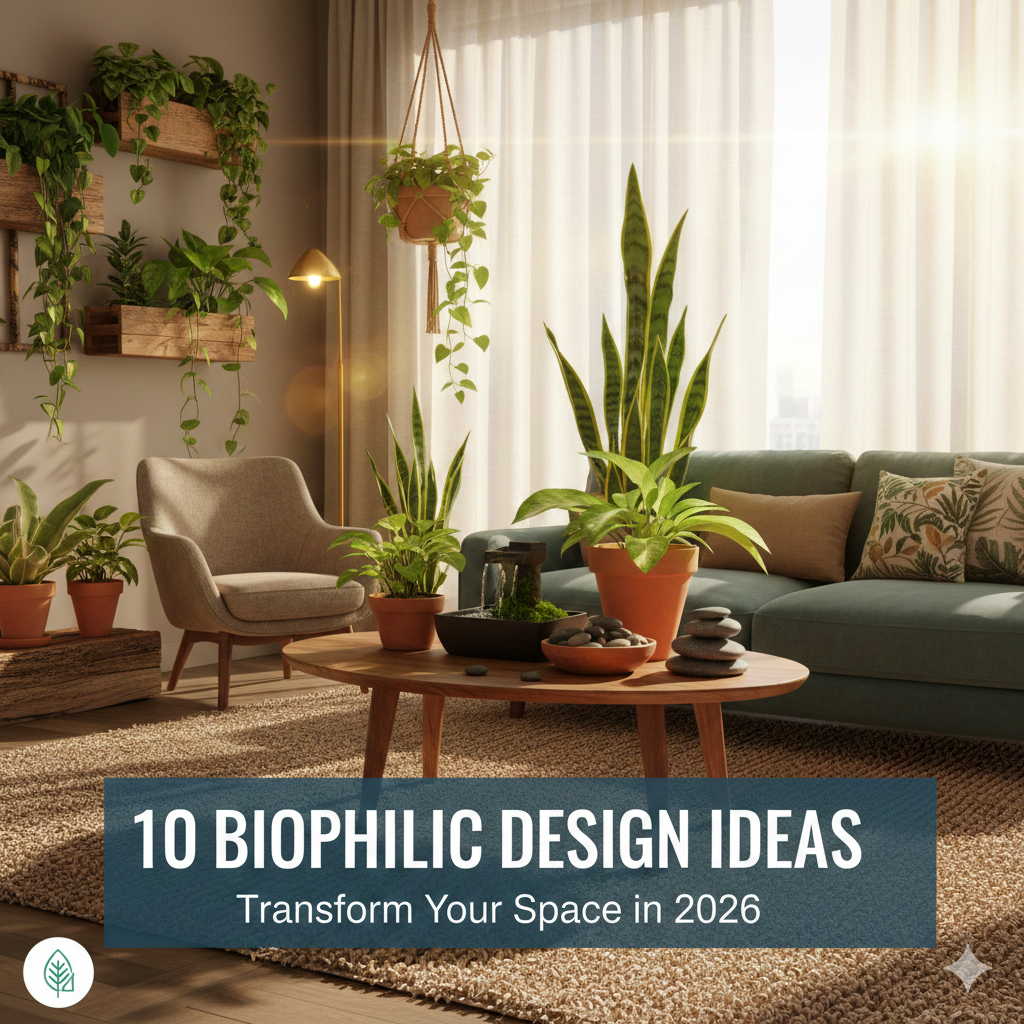
We spend roughly 90% of our lives indoors, yet our biology is still hardwired for the savanna. This “evolutionary mismatch” is why your sterile, gray home office feels soul-crushing by 3:00 PM. You aren’t lazy; you’re just starved for nature.
Biophilic design isn’t just about buying a random fern and hoping it survives your low-light living room. It’s a deliberate strategy to integrate natural patterns into your home to lower cortisol and boost creativity.
In this guide, you will learn:
- The essential elements of biophilic design that actually impact your mood.
- 10 budget-friendly ways to bring the outdoors in.
- The “Three-Layer Rule” for natural lighting.
- Common mistakes that turn “indoor jungles” into “indoor chores.”
What is Biophilic Design?
At its core, biophilic design is the practice of connecting a building’s occupants more closely to nature. In 2026, this has moved beyond “plant parenthood” into a sophisticated focus on natural textures, fractal patterns, and circadian lighting.
It’s about more than aesthetics. Peer-reviewed data suggests that even a brief visual connection to nature can lower heart rates and improve cognitive function by up to 15%. For the beginner, the goal isn’t to build a literal waterfall in the foyer—it’s to mimic the “feeling” of the wild.
1. Prioritize Dynamic Natural Light
Most people think “light” means “big windows,” but the quality of light matters more than the quantity. Natural lighting should be dynamic, shifting in intensity and color throughout the day to sync with your internal clock.
Avoid heavy, light-blocking curtains. Instead, use sheer linen drapes that allow light to filter through while maintaining privacy. If you have a dark corner, a well-placed mirror can bounce sunbeams into the shadows, mimicking the dappled light of a forest floor.
2. Incorporate Fractal Patterns
Nature rarely uses perfectly straight lines. Look at a snowflake, a leaf’s veins, or a seashell; they all feature fractal patterns—mathematical structures that repeat at different scales.
Our brains find these patterns inherently soothing because they are easy to process. You can introduce this by choosing botanical-print textiles, textured wallpapers, or even a simple “living” rug with a high-low pile. These subtle visual complexities reduce mental fatigue.
3. The Power of Natural Textures
If you can’t see nature, you should at least be able to feel it. Replacing cold plastics and synthetic fibers with natural textures is one of the fastest ways to ground a room.
- Jute and Sisal: Excellent for high-traffic floor areas.
- Reclaimed Wood: Adds “visual warmth” and a sense of history.
- Stone and Terracotta: Use these for coasters, planters, or small decorative trays to add tactile weight to your surfaces.
4. Use “Nature-Analog” Color Palettes
Steer clear of “hospital white” or “corporate gray.” To achieve a true biophilic design feel, look at the colors found in your local landscape.
This doesn’t mean everything has to be green. Think of the earthy ochres of a desert, the deep teals of a lake, or the soft taupes of river stones. These “analog” colors create a cohesive environment that feels like an extension of the world outside.
5. Curate a “Low-Maintenance” Indoor Jungle
The biggest mistake beginners make is buying high-maintenance plants that die within a month, causing “plant guilt.” A dead plant is the opposite of biophilia; it’s a stressor.
Start with “indestructible” species like the Snake Plant (Sansevieria) or ZZ Plant. These thrive on neglect and low light. Arrange them in clusters rather than scattering them individually; in nature, plants grow in communities, and seeing them grouped together creates a more impactful “green” visual.
6. Introduce “Non-Rhythmic” Sensory Stimuli
Nature is full of subtle, unpredictable movements—a breeze fluttering a leaf or the sound of water. These are “non-rhythmic” stimuli that keep our brains gently engaged without being distracting.
You can replicate this with:
- Tabletop Water Fountains: The white noise masks city sounds and adds humidity.
- Open Windows: Allowing a breeze to move your curtains creates “soft fascination.”
- Wind Chimes: Placed near an air vent or window for a gentle acoustic layer.
7. Embrace Curved Silhouettes
Modern furniture is often dangerously sharp. In biophilic design, we prioritize curvilinear forms.
Swap a rectangular coffee table for an oval one, or choose a sofa with rounded edges. These shapes mirror the organic forms of hills, clouds, and bodies of water, making a room feel safer and more inviting to the subconscious mind.
8. Focus on “Prospect and Refuge”
Humans feel best when they have a clear view of their surroundings (prospect) but feel protected from behind (refuge). This is why we love booths in restaurants.
You can create “refuge” by placing your favorite reading chair in a corner with a high back or a floor lamp overhead. Ensure that from this “nest,” you have a clear view of a window or the rest of the room. This layout triggers a deep-seated sense of security.
9. Scent: The Forgotten Dimension
Biophilia isn’t just visual. Our sense of smell is tied directly to the limbic system, which governs emotions.
Avoid synthetic “ocean breeze” candles. Instead, use essential oil diffusers with wood-based scents like Cedarwood, Sandalwood, or Balsam Fir. These contain phytoncides—organic compounds plants emit to protect themselves—which have been shown to boost immune system activity when inhaled.
10. Maximize Vertical Greenery
If you live in a small apartment, don’t take up floor space. Use your walls. Vertical gardens or simple wall-mounted planters allow you to surround yourself with greenery without tripping over pots.
A simple “living wall” can be as basic as a repurposed bookshelf filled with trailing plants like Pothos or Heartleaf Philodendron. As they grow downward, they create a “curtain” of green that softens the hard angles of your architecture.
The “Anti-Expert” Approach: Common Mistakes to Avoid
I’ve spent a decade consulting on interior spaces, and the most common failure I see is over-complication.
- The “Museum” Mistake: People buy beautiful stones or driftwood but treat them like precious artifacts. Touch them! The benefit of natural textures comes from interaction.
- The Lighting Trap: Don’t rely on overhead “boob lights.” They flatten a room. Use floor lamps and task lighting to create shadows; shadows provide depth and mimic the way light filters through a forest canopy.
Summary: Your 30-Day Biophilic Transition
You don’t need a total renovation. Start by clearing one “zone”—perhaps your desk or bedside table. Remove the plastic clutter and replace it with one plant and one natural element (like a stone tray).
The goal of biophilic design is to create a sanctuary that breathes with you. By 2026, the home won’t just be a place where we store our things; it will be a tool for our mental health.



0 Comments