
You’ve likely spent forty minutes on a treadmill, staring at the “calories burned” display and wondering if there’s a faster way to see your abs. Or maybe you’ve avoided the weight room because you’re afraid lifting heavy will “bulk” you up without actually melting the soft spots. It’s the classic fitness crossroads: do you sweat it out on the pavement or grind it out with the iron?
The truth is, most people choose the wrong tool for their specific goals because they focus on the wrong numbers. If you’re tired of working hard without seeing the scale move, you’re in the right place.
What you will learn in this guide:
- The science behind the “Afterburn Effect” and why it matters for fat loss.
- How to balance cardio vs weight training for maximum efficiency.
- The budget-friendly way to build a fat-burning routine at home.
- Why “The Cardio Trap” is the #1 reason beginners plateau.
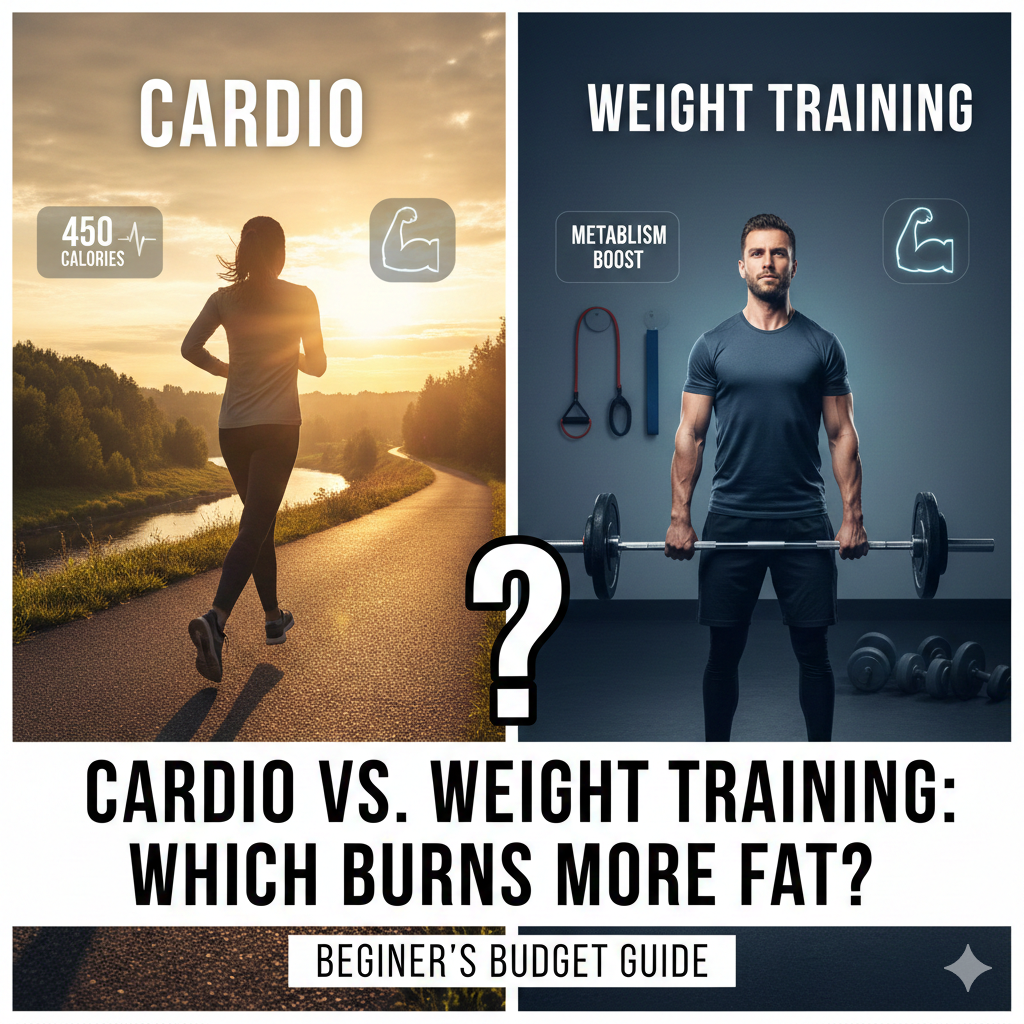
The Immediate Burn: Why Cardio Wins the Sprint
When it comes to the sheer number of calories burned during a single session, cardio is the undisputed heavyweight champion. If you run for thirty minutes, you will almost certainly burn more energy than if you lifted weights for that same thirty-minute window.
Cardio increases your heart rate and keeps it elevated, requiring a constant stream of oxygen and fuel (glucose and fat). For a beginner on a budget, cardio is the lowest barrier to entry. You don’t need a gym membership to go for a brisk walk or a run in the park; you just need a pair of decent shoes.
However, focusing solely on the cardio vs weight training debate by looking at the “calories burned” tracker on a machine is a mistake. That number only tells you what happened while you were moving, not what happens once you sit back down on the couch.
The Metabolic Engine: Why Weight Training Wins the Marathon
Weight training is an investment in your metabolic future. While you might burn fewer calories during the actual workout, lifting weights builds lean muscle mass.
Muscle is metabolically “expensive” tissue. This means your body has to spend more energy just to maintain muscle than it does to maintain fat. By increasing your muscle mass, you are effectively raising your Basal Metabolic Rate (BMR).
The Secret Weapon: EPOC
Resistance training triggers a phenomenon known as Excess Post-exercise Oxygen Consumption (EPOC), often called the “afterburn effect.” After a heavy lifting session, your body works overtime to repair muscle fibers and restore oxygen levels. This process can keep your metabolism elevated for up to 72 hours after you’ve left the gym.
The Beginner’s Trap: Why More Cardio Isn’t Always Better
A common mistake beginners make is falling into the “Cardio Trap.” They start a weight loss journey, see some initial success with running, and then hit a plateau. To break the plateau, they run more.
This often leads to muscle wasting. When you do excessive cardio in a calorie deficit without any resistance training, your body may begin to break down muscle tissue for energy. You might weigh less on the scale, but your body fat percentage remains high—a state often referred to as “skinny fat.”
Common Fat Loss Mistakes
- Ignoring Protein: You can’t build the muscle needed to burn fat if you aren’t feeding your body the building blocks.
- Overestimating Burn: Most fitness trackers overstate the calories burned during cardio by up to 30%.
- Lack of Progression: Doing the same 20-minute walk every day will eventually stop yielding results as your body becomes efficient.
High-Intensity Interval Training (HIIT): The Middle Ground
If you’re short on time and money, High-Intensity Interval Training (HIIT) is a powerful tool. It mimics the metabolic advantages of weight training while providing the cardiovascular benefits of traditional cardio.
HIIT involves short bursts of all-out effort followed by brief recovery periods. You can do this in your living room with bodyweight movements like burpees, mountain climbers, and air squats. It’s a budget-friendly way to trigger that afterburn effect without needing a rack of dumbbells.
A Practical 30-Day Strategy for Beginners
You don’t need a fancy gym to start losing fat. This plan focuses on bodyweight resistance and low-impact cardio to protect your joints while maximizing fat oxidation.
Phase 1: Weeks 1-2 (Building the Base)
- Monday/Wednesday/Friday: 20 minutes of bodyweight strength (Push-ups, Lunges, Planks).
- Tuesday/Thursday: 30 minutes of brisk walking or light cycling.
- Weekend: Active recovery (stretching or a long walk).
Phase 2: Weeks 3-4 (Increasing Intensity)
- Monday/Wednesday/Friday: 30 minutes of strength training. Add “time under tension” by slowing down your movements.
- Tuesday/Thursday: 20 minutes of HIIT (30 seconds work / 30 seconds rest).
- Weekend: One 45-minute steady-state cardio session (hiking or swimming).
The “Budget Fitness” Reality Check
Many people believe they can’t start weight training because they can’t afford a gym. This is a myth that keeps people from reaching their goals.
Your body doesn’t know the difference between a $50,000 cable machine and a gallon of water used as a weight. Gravity is free. You can use a backpack filled with books for squats or sturdy chairs for dips. The goal is to create mechanical tension in the muscle, which signals your body to keep its muscle and burn its fat.
Nutrition: The Silent Partner
No amount of cardio vs weight training will save a poor diet. Fat loss happens in the kitchen; fitness happens in the gym.
To lose fat effectively, you need a slight caloric deficit, but you must keep your protein high to preserve muscle. Think of protein as the “security guard” for your muscles. When your body looks for energy to burn, high protein intake tells it to look at your fat stores instead of your biceps.
Data-Backed Insights: What the Science Says
Studies consistently show that the most successful “weight losers” (those who keep the weight off for more than three years) utilize a combination of both modalities.
A study published in the Journal of Applied Physiology found that while cardio resulted in more immediate weight loss, resistance training was the only way to significantly increase lean body mass. When the two were combined, participants saw the greatest reduction in waist circumference and overall body fat percentage.
Which One Should You Choose?
The answer depends on your “Why.”
- Choose Cardio if: You want to improve heart health, increase endurance, or have a high-stress job and need the “meditative” aspect of a long run.
- Choose Weight Training if: You want to change the shape of your body, boost your long-term metabolism, and stay functional as you age.
The Hybrid Approach: For 90% of people, a 70/30 split is ideal. Spend 70% of your gym time on resistance training to build the engine, and 30% on cardio to keep the engine clean and efficient.
Summary: The Final Verdict
In the battle of cardio vs weight training, there is no loser—only different tools for different jobs. Cardio burns more fat per minute during the workout, but weight training turns your body into a fat-burning machine all day long.
If you are a beginner on a budget, start by walking more and using your own body weight for resistance three times a week. Consistency will always beat intensity.
Ready to start your journey? Pick one bodyweight exercise (like squats) and one form of cardio (like walking) and do them today.



0 Comments