
10 Incredible Ways Generative AI is Solving Global Challenges
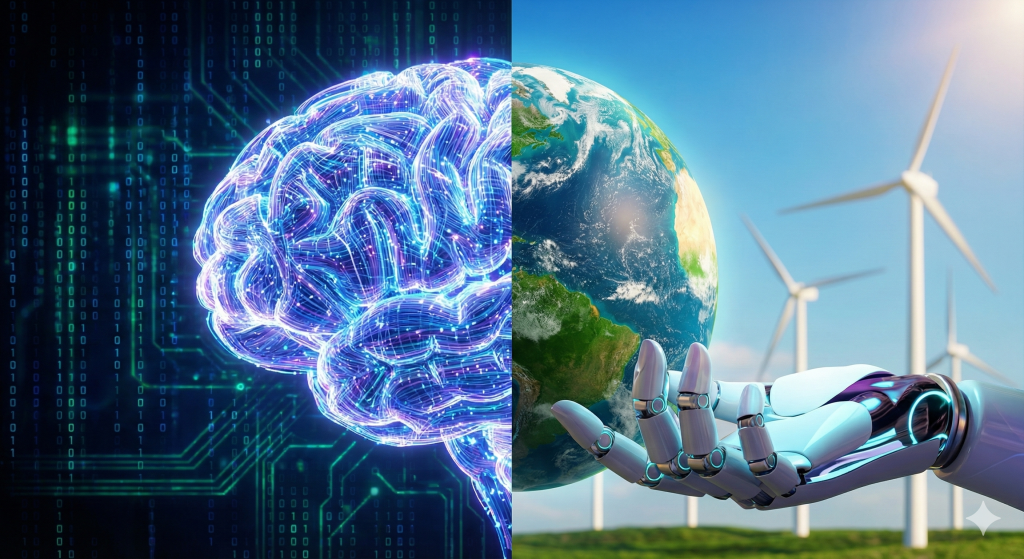
The headlines are often dominated by doom-scrolling narratives: climate tipping points, antibiotic resistance, and widening education gaps. It’s easy to feel paralyzed by the sheer scale of the problems facing our planet.
But while we’ve been worrying about robots taking our jobs, generative AI is solving global challenges that human ingenuity alone has struggled to crack for decades. We aren’t just talking about writing emails or generating images; we are talking about redesigning enzymes to eat plastic and predicting floods before they destroy villages.
What You Will Learn:
- How AI is moving from “generative text” to “generative science.”
- Real-world case studies where AI is currently fixing broken supply chains, curing diseases, and saving languages.
- The data-backed reality of AI’s role in sustainability (beyond the hype).
1. Accelerating Drug Discovery and Antibiotic Resistance
The traditional drug discovery timeline is a nightmare: 10+ years and billions of dollars. We simply don’t have that kind of time, especially with “superbugs” becoming resistant to our current antibiotics.
Generative AI acts as a biological architect. Instead of testing random compounds in a lab, AI models simulate how molecules interact with biological targets in 3D space.
- The Breakthrough: Researchers at MIT used deep learning to identify Halicin, a powerful antibiotic capable of killing drug-resistant bacteria.
- How it works: The AI didn’t just search a database; it learned the molecular structures associated with antibacterial activity and “generated” predictions for molecules humans hadn’t considered.
This turns a decade-long process into a matter of days.
2. Designing Climate-Resilient Crops (Smart Agriculture)

By 2050, we need to feed nearly 10 billion people. Doing that on a warming planet with unpredictable weather patterns is our massive hurdles.
Generative AI is transforming agriculture from a guessing game into precision engineering. It analyzes satellite imagery, soil data, and weather patterns to generate predictive farming models.
Key Applications:
- Genetic Optimization: AI models suggest gene edits to CRISPR researchers to create crops that are drought-resistant or vitamin-fortified.
- Precision Resource Use: AI generates precise irrigation schedules, reducing water waste by up to 30% in water-scarce regions.
3. Revolutionizing Materials Science for Clean Energy
We all want electric vehicles and solar panels, but the batteries required to store that energy rely on scarce minerals like cobalt and lithium.
Generative AI is solving global challenges in energy by hallucinating new materials. Just as ChatGPT predicts the next word in a sentence, materials science AI predicts the next stable structure for a battery cathode.
A recent deep-learning tool discovered 2.2 million new crystals, including 380,000 stable materials that could power the next generation of batteries, superconductors, and carbon-capture filters. This is 800 years’ worth of knowledge discovery compressed into a single afternoon.
4. Democratizing Education in Remote Areas
The global teacher shortage is acute. In many developing regions, the ratio of students to teachers makes personalized learning impossible.
Generative AI isn’t replacing teachers; it’s cloning the “tutor” experience. Large Language Models (LLMs) can run on relatively simple hardware to provide one-on-one mentorship in local dialects.
- The Impact: Platforms like Khan Academy are piloting AI tutors that don’t just give answers but guide students through the logic of a math problem.
- Global Reach: This technology scales. An AI tutor doesn’t get tired, and with recent compression techniques, these models can run on mobile devices in areas with spotty internet.
5. Predicting and Mitigating Natural Disasters
Climate change has made historical weather data less reliable. Past trends no longer predict future storms.
AI fills this gap by running millions of simulations to generate hyper-local disaster forecasts. Google’s “Flood Hub,” powered by AI, now covers over 80 countries, sending alerts to millions of people in flood-prone areas up to seven days in advance.
Why this matters:
Proactive, not Reactive. Traditional models react to rainfall data. Generative AI simulates thousands of potential outcomes based on current atmospheric conditions to predict the event before the rain even starts.
6. Optimizing the Global Supply Chain to Reduce Waste
Approximately one-third of all food produced globally is lost or wasted. A massive chunk of this happens in the supply chain due to inefficiency and spoilage.
Generative AI is solving global challenges here by creating digital twins of supply chains. It generates simulations of logistics networks to identify bottlenecks and predict demand spikes with eerie accuracy.
Real-world application: Supermarkets are using AI to predict exactly how many strawberries to order based on local weather, upcoming holidays, and historical foot traffic, drastically cutting food waste.
7. Cleaning Our Oceans with Autonomous Detection
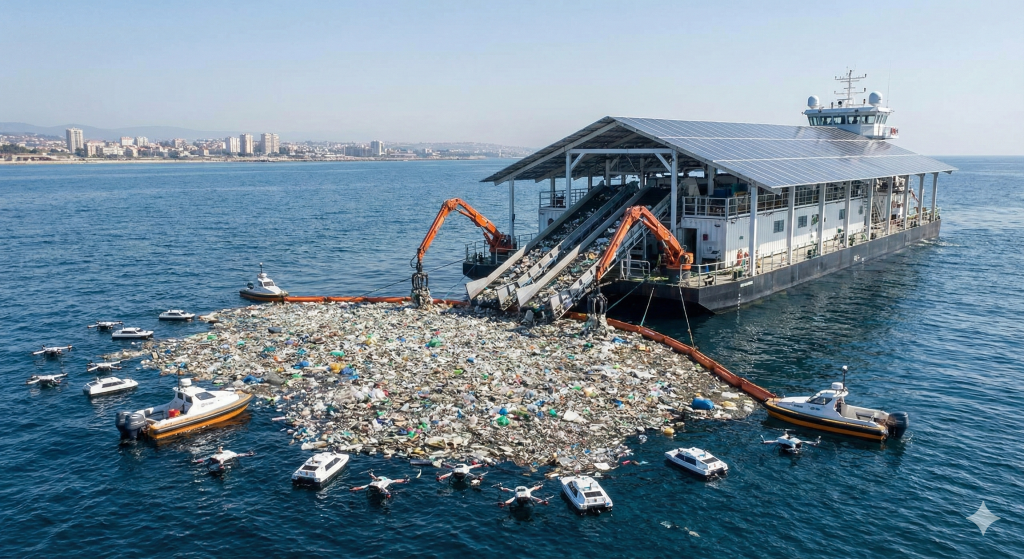
Plastic pollution is choking our oceans. The Great Pacific Garbage Patch is growing, and manual cleanup is too slow.
AI-powered vision systems are being deployed on autonomous cleanup vessels. These systems don’t just “see”; they distinguish between marine life and debris in real-time.
- Generative Training: To train these robots, developers use generative AI to create synthetic images of trash in various lighting and water conditions. This trains the robot to spot plastic faster than a human ever could, without needing millions of real-world photos.
8. Preserving Endangered Languages
Of the world’s 7,000 languages, nearly half are at risk of extinction. When a language dies, we lose unique cultural knowledge and history.
Generative AI is acting as a cultural archivist. By feeding models limited recordings of spoken dialects (like Maori or Icelandic), AI can learn the grammar and syntax to generate textbooks, translations, and learning apps.
It helps revitalize communities by allowing younger generations to interact with their ancestral language through modern interfaces.
9. Breaking Down Accessibility Barriers
For the 1.3 billion people living with disabilities, the digital and physical worlds are often inaccessible.
Generative AI is solving global challenges in accessibility by acting as a universal translator for the senses.
- Visual to Audio: Apps like Be My Eyes use generative vision to describe surroundings to blind users in rich detail (“There is a red can of soup on the middle shelf”).
- Speech to Text: Real-time, high-accuracy captioning for the deaf, even in noisy environments, is now possible thanks to advanced AI noise cancellation and context awareness.
10. Accelerating Nuclear Fusion Research

Fusion is the “holy grail” of clean energy—infinite power with zero carbon emissions. The problem is controlling the superheated plasma, which is unstable and chaotic.
Deep learning reinforcement models have recently taught themselves how to manipulate the magnetic coils inside a tokamak reactor to keep the plasma stable.
The Result: AI achieved plasma configurations that human physicists hadn’t calculated, inching us closer to a commercial fusion reactor. This isn’t just an upgrade; it’s a paradigm shift in energy physics.
The Reality Check: Data and Implementation
We must be realistic. AI is a tool, not a magic wand.
According to a recent report by the World Economic Forum, while 87% of supply chain leaders plan to implement AI, only a fraction have successfully scaled it.
The challenge isn’t the technology; it’s the data infrastructure. For generative AI to solve hunger or cure cancer, it needs high-quality, unbiased data. Garbage in, garbage out. The next decade will not just be about building smarter models, but about building better data pipelines to feed them.
Conclusion: The Era of “Generative Action”
We are moving past the novelty phase of AI. The question is no longer “What can AI write?” but “What can AI solve?”
From stabilizing fusion reactors to preserving the voices of our ancestors, generative AI is solving global challenges by compressing the time required for innovation. It gives us a fighting chance against the clock.
Your Next Step:
Don’t just read about the revolution—engage with it. If you are in business, audit your supply chain for waste. If you are in tech, look for open-source climate datasets. The tools are here; it’s time to pick them up.



0 Comments