
How to Boost Your Metabolism in Just 7 Days
You’ve likely felt the frustration of doing “everything right”—hitting the gym, cutting calories, and skipping dessert—only to see the scale refuse to budge. It feels like your body is actively working against you, stuck in a sluggish gear that no amount of willpower can shift. The truth is, your metabolic rate isn’t a fixed number; it’s a dynamic system influenced by daily habits that either stoke the fire or dampen the flames.
In the next week, we aren’t looking for “miracle pills” or expensive supplements that promise the world and deliver nothing. Instead, you will learn the exact biological levers you can pull to boost your metabolism naturally. We will cover why your current “clean eating” might be backfiring, the science of thermic effects, and a day-by-day framework to revitalize your energy levels.
The “Starvation Mode” Myth: Why Less Isn’t Always More
The most common mistake beginners make is drastically cutting calories. When you drop your intake too low, your body enters a protective state called adaptive thermogenesis. Essentially, your brain signals your metabolism to slow down to conserve energy because it thinks food is scarce.
To boost your metabolism, you must convince your body it is in a state of abundance, not a famine. This starts with fueling your cells correctly rather than depriving them. By shifting your focus from “how much can I cut” to “how well can I fuel,” you flip the switch from storage mode to burn mode.
1. Prioritize the Thermic Effect of Food (TEF)
Not all calories are processed by your body in the same way. The Thermic Effect of Food (TEF) refers to the energy your body uses to digest, absorb, and process nutrients.
The Protein Powerhouse
Protein has a much higher TEF compared to fats or carbohydrates. While your body uses about 5-10% of the energy from carbs and 0-3% from fats to digest them, it uses a staggering 20-30% of the energy from protein just for digestion.
- Actionable Step: Aim for 25-30 grams of protein at every meal this week.
- Budget Options: Eggs, lentils, canned tuna, and Greek yogurt are cost-effective ways to hit these targets.
- The Benefit: High protein intake also helps preserve lean muscle mass, which is the primary driver of your resting metabolic rate.
2. Master “NEAT” for Maximum Caloric Burn
When people think about metabolism, they usually think about the hour they spend at the gym. However, Non-Exercise Activity Thermogenesis (NEAT) accounts for a much larger portion of your daily energy expenditure than your actual workout.
NEAT includes everything from walking to the mailbox to fidgeting at your desk. If you want to see results in 7 days, you need to increase your movement outside of the gym.
Simple Ways to Increase NEAT
- The 10-Minute Rule: Walk for 10 minutes immediately after each meal. This aids digestion and blunts blood sugar spikes.
- Standing Desks: If you work a desk job, stand for 20 minutes of every hour.
- The “Long Way” Habit: Park at the back of the lot or take the stairs instead of the elevator.
3. Hydration and the Temperature Trick
Water is the medium in which almost every metabolic reaction occurs. Even mild dehydration can slow down your cellular processes.
A unique angle often overlooked is the metabolic efficiency of drinking cold water. When you consume ice-cold water, your body must expend energy (calories) to heat that water to internal body temperature. While the burn per glass is small, it adds up significantly over a week.
Expert Insight: Studies suggest that drinking 17 ounces (500ml) of water can increase resting metabolism by 24-30% for about an hour afterward.
4. Why Sleep is Your Secret Metabolic Weapon
You can have the perfect diet and exercise routine, but if you are sleeping five hours a night, your metabolism will stall. Sleep deprivation causes a spike in cortisol, a stress hormone that encourages fat storage, particularly around the midsection.
Furthermore, lack of sleep disrupts ghrelin (the hunger hormone) and leptin (the fullness hormone). This leads to intense cravings for high-sugar, high-fat foods the following day, sabotaging your efforts to boost your metabolism.
Your 7-Day Sleep Protocol
- Set a Caffeine Cut-off: No caffeine after 2:00 PM.
- Screen-Free Zone: Turn off blue-light devices 60 minutes before bed.
- Consistent Timing: Go to bed and wake up at the same time every day for the next week.
5. Resistance Training vs. Steady-State Cardio
While running on a treadmill burns calories in the moment, it doesn’t do much for your metabolism once you step off. To turn your body into a 24/7 burning machine, you need to build muscle.
Muscle tissue is metabolically expensive, meaning it requires more energy to maintain than fat tissue. Even at rest, a person with more muscle will have a higher metabolic efficiency.
- Beginner Tip: Focus on compound movements like squats, lunges, and push-ups.
- The “Afterburn”: High-Intensity Interval Training (HIIT) creates an oxygen debt that keeps your metabolism elevated for hours after the workout ends, a phenomenon known as EPOC (Excess Post-exercise Oxygen Consumption).
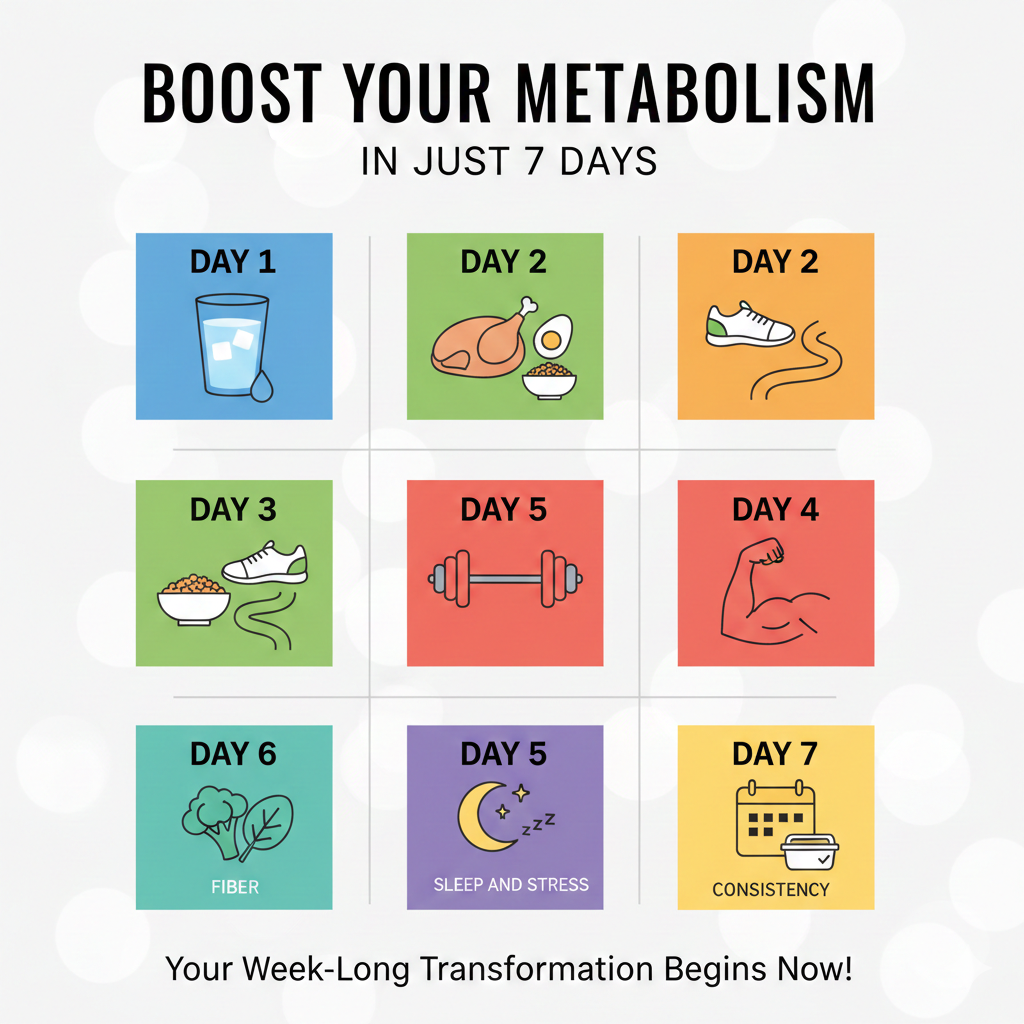
The 7-Day Metabolism Kickstart Schedule
| Day | Focus Area | Primary Action |
| Day 1 | Hydration | Drink 3 liters of water; start the “10-minute walk” rule. |
| Day 2 | Protein | Ensure every meal has a palm-sized portion of protein. |
| Day 3 | Movement | Aim for 10,000 steps through NEAT (no formal gym required). |
| Day 4 | Strength | Complete a 20-minute bodyweight resistance circuit. |
| Day 5 | Stress/Sleep | Practice 10 minutes of box breathing; get 8 hours of sleep. |
| Day 6 | Fiber | Add 2 servings of green vegetables to every meal to improve gut health. |
| Day 7 | Consistency | Review the week and meal prep protein for the following Monday. |
Common Mistakes That Kill Your Progress
- Over-relying on “Fat Burners”: Most store-bought supplements are just overpriced caffeine. Focus on whole foods.
- Liquid Calories: “Healthy” smoothies are often sugar bombs that spike insulin and stop fat burning.
- Ignoring NEAT: Doing a 30-minute workout and then sitting for 10 hours cancels out much of the metabolic benefit.
Practical Evidence: Small Changes, Big Results
In my experience working with individuals looking for sustainable weight management, the most significant shifts don’t come from radical overhauls. One specific case involved a client who simply increased their daily protein and added a 15-minute morning walk. Within a week, their midday “energy crashes” disappeared, and their resting heart rate stabilized—clear indicators of an optimizing metabolism.
Data shows that metabolic efficiency is closely tied to blood sugar stability. By avoiding the “rollercoaster” of high-sugar snacks, you allow your body to access stored fat for fuel more effectively.
Taking the First Step
Boosting your metabolism isn’t about punishing your body; it’s about providing it with the right signals. By prioritizing protein, increasing your daily movement, and respecting your sleep cycle, you create an environment where your body wants to burn energy.
The next seven days are an opportunity to reset your internal engine. Pick one habit from this list—perhaps the post-meal walk or the protein goal—and start today.
Would you like a customized grocery list or a 15-minute home workout plan to help you hit these goals? Let’s get started on your transformation.



0 Comments