
Vitamin C vs Retinol: The Ultimate Guide to Picking Your Skincare MVP
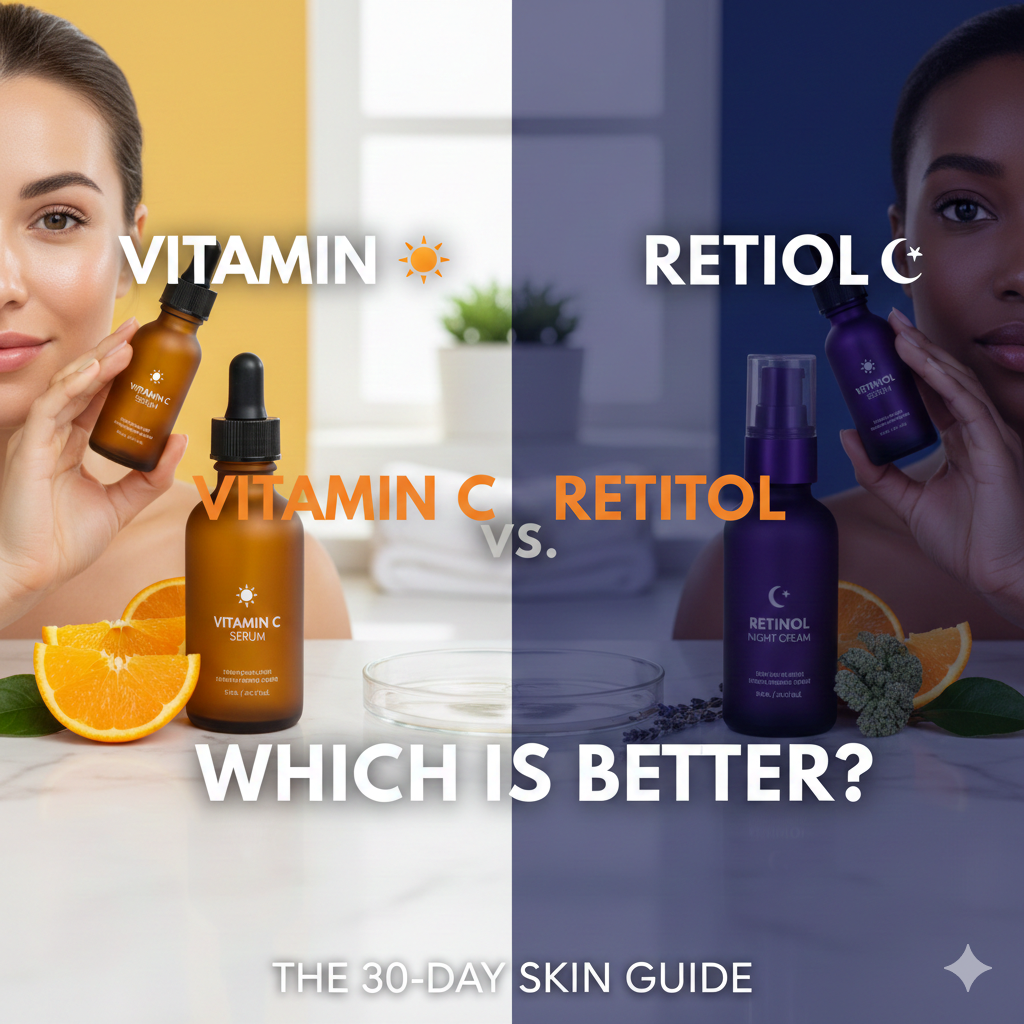
You’ve likely stood in the skincare aisle, staring at two bottles that promise the world. One claims to brighten your skin like a literal lightbulb, while the other promises to hit the “undo” button on fine lines and texture. If you’re on a budget, buying both feels like a luxury your wallet isn’t ready for, and picking the wrong one feels like a waste of thirty bucks.
The “Vitamin C vs Retinol” debate isn’t about which ingredient is objectively superior; it’s about which one your skin actually needs right now. Most beginners make the mistake of choosing based on hype rather than their specific skin barrier health. In this guide, we’re going to strip away the marketing fluff and look at the raw data to help you decide.
What you will learn in this guide:
- The fundamental biological differences between Vitamin C vs Retinol.
- Why the “more is better” approach leads to most beginner breakouts.
- A budget-friendly 30-day “Skin Transformation” roadmap.
- How to spot high-quality formulas without the designer price tag.
Understanding the Heavy Hitters: What Do They Actually Do?
To choose the right tool, you have to understand the job. Imagine your skin is a house: Vitamin C is the protective paint and sealant that keeps the elements out, while Retinol is the structural engineer that fixes the foundation.
Vitamin C: The Daily Bodyguard
Vitamin C (specifically L-ascorbic acid) is a potent antioxidant. Its primary job is to neutralize free radicals—unstable molecules caused by UV rays and pollution that “rust” your skin cells.
When you use Vitamin C, you are effectively preventing damage before it happens. It inhibits melanin production, which is why it’s the gold standard for fading dark spots and achieving that elusive “glow.”
Retinol: The Midnight Repair Crew
Retinol is a derivative of Vitamin A. Unlike Vitamin C, which works largely on the surface and upper layers, Retinol communicates directly with your skin cells.
It tells them to speed up turnover, bringing fresh, new cells to the surface faster. This process treats anti-aging concerns, acne, and deep-seated texture by forcing the skin to constantly renew itself.
Vitamin C vs Retinol: Which is Better for Your Specific Goal?
If you are working with a limited budget, you need to prioritize. Let’s break down common skin concerns and see which ingredient wins the round.
1. If Your Goal is Brightening and Fading Sun Spots
Winner: Vitamin C
If you spent a little too much time in the sun in your teens and now have “sun-kissed” spots that won’t leave, Vitamin C is your best friend. It acts as a tyrosinase inhibitor, which basically means it tells your skin to stop overproducing pigment.
2. If Your Goal is Smoothing Fine Lines and Wrinkles
Winner: Retinol
Retinol is one of the few over-the-counter ingredients actually proven to stimulate collagen production. While Vitamin C helps support collagen, Retinol is the one doing the heavy lifting. For anti-aging results that you can actually see in the mirror, Retinol takes the trophy.
3. If You Have Sensitive, Reactive Skin
Winner: Vitamin C (with a caveat)
Retinol is notorious for the “purge”—a period of redness and peeling. If you have sensitive skin and a low budget, a gentle Vitamin C derivative like Sodium Ascorbyl Phosphate is much safer than a harsh Retinol that might require expensive “recovery” creams.
The Unique Angle: The 30-Day “Active Ingredient” Roadmap
Most people fail with these ingredients because they try to do too much too fast. They buy a 20% Vitamin C and a 1% Retinol, apply them both on day one, and wake up with a chemical burn.
Here is a budget-friendly 30-day plan to integrate these without ruining your skin barrier.
Week 1-2: The Protective Phase (Vitamin C Only)
- Morning: Apply Vitamin C serum to clean, dry skin. Follow with a cheap, basic moisturizer and SPF 30+.
- Night: Just cleanse and moisturize. Let your skin get used to the acidity of the Vitamin C.
- The Goal: Build antioxidant protection and check for any irritation.
Week 3-4: Introducing the Repairman (The “Sandwich” Method)
- Morning: Continue Vitamin C + SPF.
- Night (Monday and Thursday only): Apply moisturizer, then a pea-sized amount of Retinol, then another layer of moisturizer.
- The Goal: This “sandwiching” technique buffers the Retinol, reducing the risk of peeling while your cells begin to turn over.
The Beginner’s Guide to Skincare Ingredients on a Budget
You do not need to spend $100 on a serum. In fact, many high-end brands use the same suppliers as drugstore favorites. When looking for affordable skincare, keep these “SME” (Subject Matter Expert) tips in mind:
- Packaging is King: Vitamin C oxidizes (turns brown and useless) when exposed to air and light. Never buy it in a clear glass bottle. Look for opaque, airless pumps.
- Concentration Matters: Beginners should look for 10% Vitamin C and 0.2% to 0.5% Retinol. Higher percentages aren’t “better”; they are just more irritating.
- The Ingredient List: Look for Ferulic Acid and Vitamin E alongside Vitamin C. These “boosters” make the Vitamin C more stable and effective.
Common Mistakes That Waste Your Money
I have seen thousands of dollars wasted on “miracle” products that were used incorrectly. Avoid these three traps:
- Mixing Actives in One Go: Never apply Vitamin C and Retinol at the exact same time. The pH levels required for each to work are different, and they often cancel each other out or cause extreme irritation.
- Skipping Sunscreen: Using Retinol without sunscreen is like washing your car in a rainstorm. Retinol makes your skin more sensitive to the sun; skipping SPF will actually accelerate the aging you’re trying to fix.
- Expecting Overnight Results: Skin cells take about 28 to 40 days to renew. If you ditch a product after two weeks because you don’t see a change, you’ve wasted your money.
Real Talk: Practical Experience with Dermatology Basics
In my years of analyzing skincare formulations, I’ve found that the “best” product is the one you actually use consistently. I once worked with a client who spent a fortune on a 1% Retinol but hated the flaking so much she stopped using it.
We switched her to a $12 “Retinyl Palmitate” (a weaker derivative) used three times a week. Six months later, her skin looked better than ever. Consistency beats intensity every single time.
Summary: Making Your Choice
If you can only afford one today:
- Choose Vitamin C if you work outdoors, struggle with dullness, or have dark spots.
- Choose Retinol if you are over 25 and your primary concern is texture, pores, or fine lines.
The “Vitamin C vs Retinol” debate ends when you realize they are partners, not rivals. Use Vitamin C to protect your day and Retinol to rebuild your night. Start slow, stay consistent, and always, always wear your sunscreen.
Ready to start your glow-up?
Check your local pharmacy for “stable” Vitamin C formulas and remember to patch test on your neck before going full-face!



0 Comments